
A Framework X database form with database
cells containing outlines, pictures and text.
cells containing outlines, pictures and text.
 What is FRAMEWORK
?
What is FRAMEWORK
?
 FRAMEWORK IX
and
FRAMEWORK X.
FRAMEWORK IX
and
FRAMEWORK X.
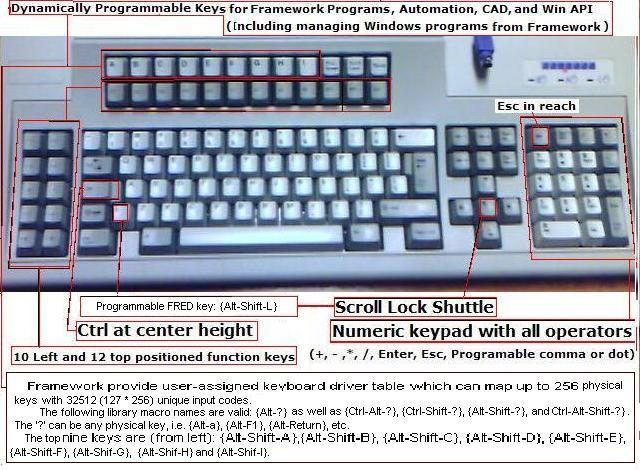 (hardware)
with function keys at left and top with additional key providing single key automated program recording
expanding Framework capabilities.
(hardware)
with function keys at left and top with additional key providing single key automated program recording
expanding Framework capabilities.


Framework is a continuation of Ashton-Tate's Framework (Framework, II, III, and IV) and the FRED computer language.
The Framework software and trademark were taken over by Selection & Functions Inc. from Borland after Ashton-Tate was taken
over by Borland. Selection & Functions Inc. with the stated goal of protecting the significant investment made by Framework
users and FRED programmers in this unique technology and concepts. The current Windows versions of Framework which are
available to Framework users are fully compatible with the original Framework methods and user interface, files, macros,
FRED programs, libraries and dictionaries, while providing transparent compatibility with Windows programs and data.
Copying between Framework and Windows MS Word, Excel, HTML, Internet e-mail, and most other programs
preserves text style and format as well as spreadsheet cell and database field values.
Images cut by Framework, including pictures opened in Framework (JPG, GIF, BMP, etc.) can be pasted into Windows
graphic programs such as MS Paint and Photoshop.
Framework extensive "Windowing" capabilities allows the Framework desktop to grow larger
than the Windows screen. A larger than screen desktop can be scrolled up down and left right with documents
(which may include pictures) placed freely side by side or overlapped for viewing and comparison.
A Framework menu can be toggled between "always on top" keeping the Framework window on top of other Windows or
behaving as a normal Windows which can be covered by other Windows when not in focus.
program.
A Framework menu creates secondary "view windows" which can be sized, positioned and scrolled
as independent Framework desktop viewer windows. They can be updated with changes "broadcasted"
from Framework when the Framework desktop is updated. just like the Framework main desktop those
multiple "view windows" can be positioned and sized to show "larger than screen" are with
documents freely positioned in them and the ability to move them around using the mouse.
They can be broadcasted to over the Internet to be shared interactively with individuals
or posted on public sites.
Framework's mouse functionality is selection based and time independent. Multiple mouse click operations are deciphered
by the number of clicks, not the time interval between them. Mouse clicks actions are user defined and user programmable.
They can be directed to run pre-recorded Library macros, standard keyboard keys, and FRED programs as well as
Windows API programs. Mouse actions are equivalent to Framework's standard command keys. Mouse-over help tips shows
the equivalent key-commands familiar to Framework users.
Framework provides a productivity suite with unlimited expendability, standard organization of data
and knowledge in a context based language like programmable environment. Among its features are fast filing, outlining,
recording of macros in a consistent predictable environment, user programmability, linking and search tools,
dynamic switching between languages, automatic creation of hypertext, automatic database filtering, extensive
programming capabilities with access to Windows DLL's and GUI on top of an environment supporting graphics and
desktop publishing.
Framework takes advantage of a new dynamic state machine technology providing instant input
parsing and among other things, a mass storage industrial strength indexless
databases providing close to instant data access independent of data size. This
mass storage database system provides hard drive persistency and is limited in size only by
the available hard drive space. This independent mass storage system is in addition Framework's
support of Ashton-Tate's dBase files and indexes provided for back compatibility with dBase files.
Framework's support for programming ranges from user recorded macros through the
FRED language interactive interpreter, to Windows DLL and Windows API programs.
For programers (or aspiring thereof) a 32 bit Windows API Pascal compiler compatible with Turbo Pascal is
available. And for the time being (while on Intel compatible machines) the LLI DTK (with no exceptions)
is a alive and well.
The Framework technology architecture is not tied up to Windows. It consists of OS independent modular cores,
including a portable packet data server and modular OS-specific interface.
It allows Framework to run via wireless or network connectivity on different platforms.
The Framework technology include external file format handlers which can handle other programs
file formats in Framework frames applying all the normal Framework features and interface
including outlining and free floating to them. Framework to operate remotely on different operating
systems via dedicated agents.

More on Framework's concept, features and look and feel:
Framework's outlined windowing environment with word processing, spreadsheets, databases, file and directory management,
data management, integrated hypertext, integrated interpreter, rapid development computer language and a slew of
unique features and tools not available in any other software. Framework is unique in its unified context-based
object-driven user interface which is based on selection capabilities and set based architecture.
Framework IV Hypertext engine transparently displays and creates links. It includes the FRED language on-disk manuals. FRED is a text-aware rapid development interpreter programming language constantly active under Framework. Framework VIII evaluates selected text processing arithmetic, dates, Hypertext links or Framework reference names and program code anywhere in text.

